Real Estate Chatbot Scripts: 5 Flows That Qualify Buyers
Five copy-paste real estate chatbot scripts for property developers — new home, investor, off-plan, international and rental flows that qualify buyers.
A real estate chatbot script is not a list of questions. It is a path — from "anonymous visitor" to "qualified lead with a next step" — in as few taps as possible. Bad bots interrogate: they ask ten things, store the answers nowhere useful, and end with "thanks, we'll be in touch." Good bots route: every answer narrows what happens next, and every path ends in a concrete action.
Before the templates, the four rules that make any chatbot conversation flow work:
- •One question at a time. A wall of form fields in chat clothing is still a form.
- •Buttons, not typing. Every tap is effortless; every keystroke is a chance to leave.
- •Every answer changes the next question. If an answer doesn't affect what the bot does next, delete the question.
- •Every path ends in an action. WhatsApp, a booked viewing, a priority list — never a dead end.
If you are new to the format itself — what an in-page bot is and why it outperforms contact forms and popup chat — start with our guide to in-page real estate chatbots, then come back for the scripts.
Each template below follows the same structure: where to use it, what the flow is trying to achieve, the script itself, where it hands off, and the mistake we see most often in that scenario. Copy them into any chatbot builder — or into Leaduu, where flows like these are configured for you.
Template 1: New home buyer flow (residential project page)
Best for: the main page of a completed or near-complete residential project. Goal: turn "just browsing" into a booked viewing with three questions.
The script:
- •Bot: "Welcome! Are you looking at this project as your future home?" → Buttons: 🏠 Yes, for myself · 👀 Just browsing
- •Bot: "How many bedrooms do you need?" → Buttons: 1 bedroom · 2 bedrooms · 3+
- •Bot: "When would you like to move in?" → Buttons: As soon as possible · Within 6 months · Within a year · Just planning ahead
- •Bot: "Will you be buying with a mortgage or in cash?" → Buttons: 🏦 Mortgage · 💶 Cash · Not sure yet
- •Bot: "Great — let's find a time for you to see the apartments that match."
Handoff: viewing booking — day and time slots inside the chat, then one contact field (email or phone). The sales team receives: bedrooms, timeline, financing, appointment request.
Common mistake: asking for contact details first. A visitor who has answered three easy questions about their future home will happily leave a phone number; a visitor asked for a phone number upfront will leave the site.
Template 2: Investor qualification flow (the Riga Waterfront script)
Best for: investment-positioned projects and pages targeting buy-to-let buyers. Goal: identify what drives this investor and hand them to a human with full context.
This is the flow running in production on Riga Waterfront — we broke down the full case in our in-page chatbot guide, and you can see the mechanics summarised on our homepage.
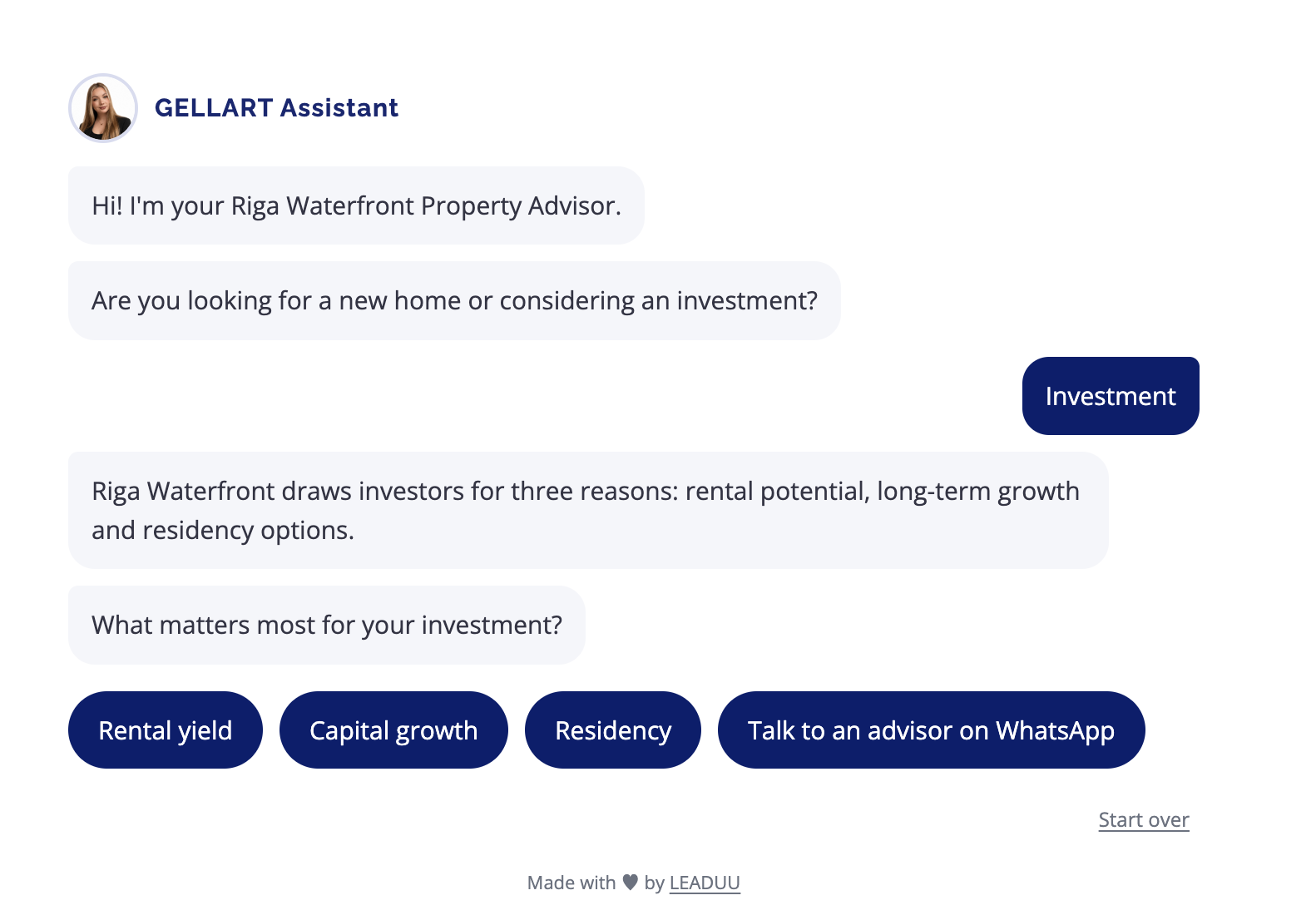
The script:
- •Bot: "Are you looking for a new home or considering an investment?" → Buttons: 🏠 New home · 📈 Investment
- •Bot: "What matters most for your investment?" → Buttons: 📊 Rental yield · 📈 Capital growth · 🛂 Residency options
- •Bot: "What budget range are you considering?" → Buttons: Under €200k · €200–350k · €350–500k · €500k+
- •Bot: "And your horizon — when would you like to move on this?" → Buttons: Ready now · This quarter · This year · Exploring
Handoff: WhatsApp, with the answers attached to the opening message. The advisor starts the conversation already knowing: investor, yield-focused, €200–350k, ready now. Speed matters here — a qualified investor answered within minutes converts at a completely different rate than one answered tomorrow, something we covered in the 5-minute rule.
Common mistake: asking investors about bedrooms and finishes. Investors buy numbers — yield, growth, exit options. Save the interior questions for Template 1.
Template 3: Off-plan and pre-launch flow
Best for: projects still under construction, or pages announcing a future phase. Goal: you cannot sell what is not finished — so build a priority list instead.
The script:
- •Bot: "Sales for this phase open soon. What are you most interested in?" → Buttons: 🏢 Specific floor or view · 🛏 A unit type · 💶 Prices and payment terms
- •Bot: "When are you planning to make a decision?" → Buttons: As soon as sales open · Within a few months · Just researching
- •Bot: "Want to be on the priority list? Early access to units and prices before the public launch." → Buttons: ⭐ Join the priority list · 📄 Send me the brochure first
- •Bot: "Where should we send it?" → *email field*
Handoff: email capture into a launch list, with an optional "Prefer WhatsApp updates?" button after the email is in. Everyone on the list also gets construction updates — each update is a legitimate reason to appear in the buyer's inbox again.
Common mistake: pushing for a sale a year before completion. The pre-launch bot's job is a warm list and permission to follow up — the selling happens at launch, to people who already feel like insiders.
Template 4: International buyer and residency flow
Best for: projects marketed abroad; pages in English targeting non-resident buyers. Goal: qualify purpose and geography, then book a video call — not a phone call.
The script:
- •Bot: "Are you currently based abroad?" → Buttons: 🌍 Yes, buying from abroad · 🏠 No, local buyer
- •Bot: "What is the main goal of your purchase?" → Buttons: ✈️ Relocating · 📈 Investment · 🛂 Residency permit
- •Bot: "Good to know — this project qualifies for residency-linked purchase. Want the details on how it works?" → Buttons: Yes, explain the process · Skip to the apartments
- •Bot: "The easiest next step is a short video call with our advisor — we'll walk you through units, paperwork and timelines. Pick a time that works in your time zone."
Handoff: video call booking with day/time slots. For a buyer eight time zones away, "call us" is friction and "book a slot" is relief — the booking flow itself is the argument.
Common mistake: treating residency as a footnote. In Baltic and Southern European markets it is often the primary driver of foreign demand — surface it as a first-class answer, not a paragraph buried in an FAQ.
Template 5: Rental and build-to-rent flow
Best for: build-to-rent products, serviced apartments, developer-managed rentals. Goal: renters decide in days, not months — get to the viewing fast.
The script:
- •Bot: "Looking to rent here? How long would you stay?" → Buttons: 6–12 months · 1 year+ · Short term
- •Bot: "When would you move in?" → Buttons: This month · Next month · Within 3 months
- •Bot: "What monthly budget are you working with?" → Buttons: three ranges tuned to your product
- •Bot: "We have units that fit. Want to see them this week?"
Handoff: viewing booking, with WhatsApp as the alternative for quick questions. Keep the whole flow under a minute — rental decisions move at rental speed.
Common mistake: reusing the buyer flow. A renter does not care about financing or capital growth; every irrelevant question costs a real percentage of completions.
How to adapt these chatbot scripts to your project
Three rules when customising:
- •Rename the options, keep the structure. "2 bedrooms" becomes "2-room apartment" or "Type B" — whatever your buyers actually see in your price list.
- •Localise properly. If your buyers speak three languages, the flow should exist in three languages — button labels included.
- •Never exceed four questions before the handoff. Each extra step costs completions; if a question doesn't change the routing or give sales something they will actually use, cut it. Qualification data is only valuable if it feeds how you prioritise leads — see our guide to lead scoring for developers.
Measure the flow like a funnel
A chatbot conversation flow is a funnel, and every step can be measured like one: how many visitors saw the first question, how many tapped an answer, how many reached the handoff, how many completed it. Once you see those numbers, improving the script stops being guesswork.
Three patterns show up again and again when developers look at their flow data for the first time:
- •A steep drop on question one means the opening question is wrong for the page — a "new home or investment?" fork on a page that only attracts investors is a wasted tap. Match the first question to what the page's traffic already tells you.
- •A drop at the budget step usually means the ranges are wrong, not that the question is. Ranges that start far above what the page's audience expects read as "this is not for you" — tune them to the actual price list.
- •A drop at the contact field means the flow asked too early or offered too little. Move the field one step later, or attach a concrete reason to it: a brochure, a price list, a held time slot.
Change one thing at a time, give it a week of traffic, and compare completion rates. A flow tuned this way for a month will quietly outperform any first draft — including the templates above.
Try a working flow before you build one
The fastest way to calibrate your own script is to click through a real one. The assistant on our homepage runs the same guided-flow engine described in this article — and the investor template is live right now on Riga Waterfront. Tap through either as if you were a buyer, count the taps, and notice where you would drop off. Then build yours one tap shorter.
Frequently asked questions
How many questions should a real estate chatbot ask?
Three to four questions before the handoff is the practical maximum. Each question should either change what the bot does next or give the sales team information they will actually use. Flows longer than four steps see completion rates drop with every added question — if an answer doesn't affect routing or follow-up, the question should be removed.
What questions qualify a property buyer?
The core qualification set for real estate is: intent (home or investment), requirement (bedrooms or unit type for home buyers; yield, growth or residency for investors), timeline (when they plan to decide or move), and budget as a range. Together these four answers tell a sales team exactly who they are talking to and how to prioritise the lead.
Should the chatbot ask for budget?
Yes — but as button ranges, never as a free-text field. Ranges feel safe to tap, remove the awkwardness of naming a number, and are precise enough for qualification. Placing the budget question after one or two easier questions also raises answer rates, because the visitor is already invested in the conversation.
When should the bot hand off to a human?
As soon as the lead is qualified and shows intent — typically after three or four answers. The handoff should carry full context (answers attached to the WhatsApp message or booking request) so the buyer never repeats themselves. Handing off too early wastes sales time on unqualified visitors; too late, and hot leads cool while talking to a robot.
Can I use the same chatbot flow for homes and investments?
Use one opening question to split them, then different branches. Home buyers and investors need different questions: bedrooms and move-in dates for one, yield, budget range and horizon for the other. A single first question — 'new home or investment?' — lets one bot serve both audiences without either seeing irrelevant steps.
Ready to convert more visitors?
Try the live Leaduu bot — the same one your visitors will see.
Try the live bot →