Real Estate Chatbot: Turn Visitors into Booked Viewings
Why in-page real estate chatbots convert more website visitors into qualified leads and booked viewings than contact forms or live chat — and how to add one.
You spent real money getting buyers to your property website — portal listings, Google Ads, Instagram campaigns, maybe a drone video that took a week to edit. The traffic arrives. And then, for most of it: nothing. Industry benchmarks put real estate website conversion at 1–3%, which means more than 95 out of every 100 visitors leave without giving you any way to follow up. They studied the floor plans, checked the prices, pictured breakfast on that balcony — and closed the tab.
A real estate chatbot exists to fix exactly this. Not the popup kind that ambushes people thirty seconds after they arrive — the in-page kind that lives inside your content, starts a useful conversation, qualifies intent with a few taps, and turns anonymous traffic into WhatsApp conversations and booked viewings.
This guide covers how an in-page chatbot works, how it compares with contact forms and live chat, what the flow looks like on a real property website, and what it takes to install one.
Why most real estate websites lose 95% of their visitors
Buying property is the definition of a high-consideration purchase. Before anyone fills in a form, they have a queue of questions: What is the price per square metre? Which units are still available? When is completion? Is financing possible? What rental yield can I expect? Does the purchase qualify for a residency permit?
A typical property website answers some of these questions somewhere — in a PDF brochure, on a pricing page, in an FAQ nobody scrolls to. The visitor is left to do the work: find the information, weigh it up, and then take the intimidating step of contacting a stranger.
That last step is where everything falls apart. The contact form demands a name and a phone number before offering anything in return, and everyone knows what happens after you give a developer your phone number. Calling feels even heavier — especially for international buyers browsing from a different time zone. So the visitor decides to "think about it," leaves, and never comes back. We looked at this pattern in detail in why property developer websites lose visitors — the short version is that friction, not lack of interest, kills most inquiries.
Chatbot vs contact form vs live chat: where leads slip away
The three standard tools for converting website visitors into leads behave very differently in practice:
| Contact form | Live chat (popup) | In-page chatbot | |
| Who makes the first move | The visitor | Operator or visitor | The bot, in context |
| Availability | Always there, but passive | Business hours | 24/7, actively engaging |
| Qualification | None | Manual, by the operator | Automatic, built into the flow |
| Typing required | Yes — several fields | Yes — free text | No — visitors tap buttons |
| Staff needed | No | Yes, a live operator | No |
| What sales receives | A bare email address | A chat transcript | Structured data: intent, budget, timeline |
The chatbot vs contact form question comes down to initiative: a form waits silently while the visitor decides whether to volunteer their details, and most never do. The chatbot vs live chat question comes down to economics and experience: popup live chat needs a human on duty to be useful, and the popup itself is the most reflexively closed element on the modern web — most visitors dismiss it before reading a word.
An in-page chatbot avoids both traps. It engages every visitor without waiting, and it does so without an operator and without interrupting anyone.
What is an in-page chatbot — and how it differs from popup chat
An in-page chatbot is a conversation embedded directly into the content of a page — a section of the page itself, not a floating widget hovering over it. The visitor scrolls, meets the bot exactly where their questions naturally arise, and interacts with it the way they would with any other part of the site.
Three things make this format work where popups fail:
- •Context. The bot on a project page talks about that project — its units, its prices, its completion date. A visitor reading about a two-bedroom apartment gets asked a relevant question about that apartment, not a generic "How can I help you today?"
- •No reflex to close it. Because the bot sits inside the page rather than covering it, there is nothing to dismiss. Visitors who are not interested simply scroll past; visitors who are interested engage. Nobody gets interrupted.
- •Guided flow — no typing. The conversation runs on buttons. The visitor taps "Investment," then "Rental yield," then a budget range. Zero effort, no blank input field asking them to compose a message to a stranger.
The result feels less like a chat widget and more like the website itself asking smart questions — which is exactly why visitors who ignore popups will happily click through a guided flow.
How a real estate chatbot qualifies leads automatically
Here is what a working flow looks like on a residential development website:
Step 1 — intent. The bot opens with one simple fork: "Are you looking for a new home or considering an investment?" One tap, and every following question can be relevant.
Step 2 — motivation. An investor gets investor questions: what matters most — rental yield, long-term capital growth, or residency options? (In Baltic and Southern European markets, the residency permit question is often the real driver behind the inquiry — a good bot surfaces it instead of hoping the buyer asks.) A home buyer gets home buyer questions: bedrooms, move-in timeline, financing.
Step 3 — budget. A range, offered as buttons. Nobody has to type a number or feel judged for it.
Step 4 — handoff. The qualified visitor chooses what happens next: continue to WhatsApp, book a property viewing online, or request a video tour. If they pick WhatsApp, the conversation opens with their answers already attached.
The value of doing this before a human gets involved is hard to overstate. Your sales manager opens WhatsApp and sees: investor, budget €250,000–350,000, interested in residency, wants a video call this week. The conversation starts in the middle, not at the beginning. Multiply that across every inquiry and the team stops burning hours on "just looking" conversations — the bot qualifies real estate leads automatically, and humans only speak with people worth speaking to. If you want ready-made scripts for this — new home buyer, investor, off-plan, international, rental — we published five chatbot flow templates you can copy into any builder.
Speed matters too: a lead answered in five minutes is dramatically more likely to convert than one answered the next morning, something we broke down in the 5-minute rule for real estate follow-up. A bot answers in under a second, at 2am on a Sunday, in the middle of your sales team's holiday.
Case study: the in-page bot on Riga Waterfront
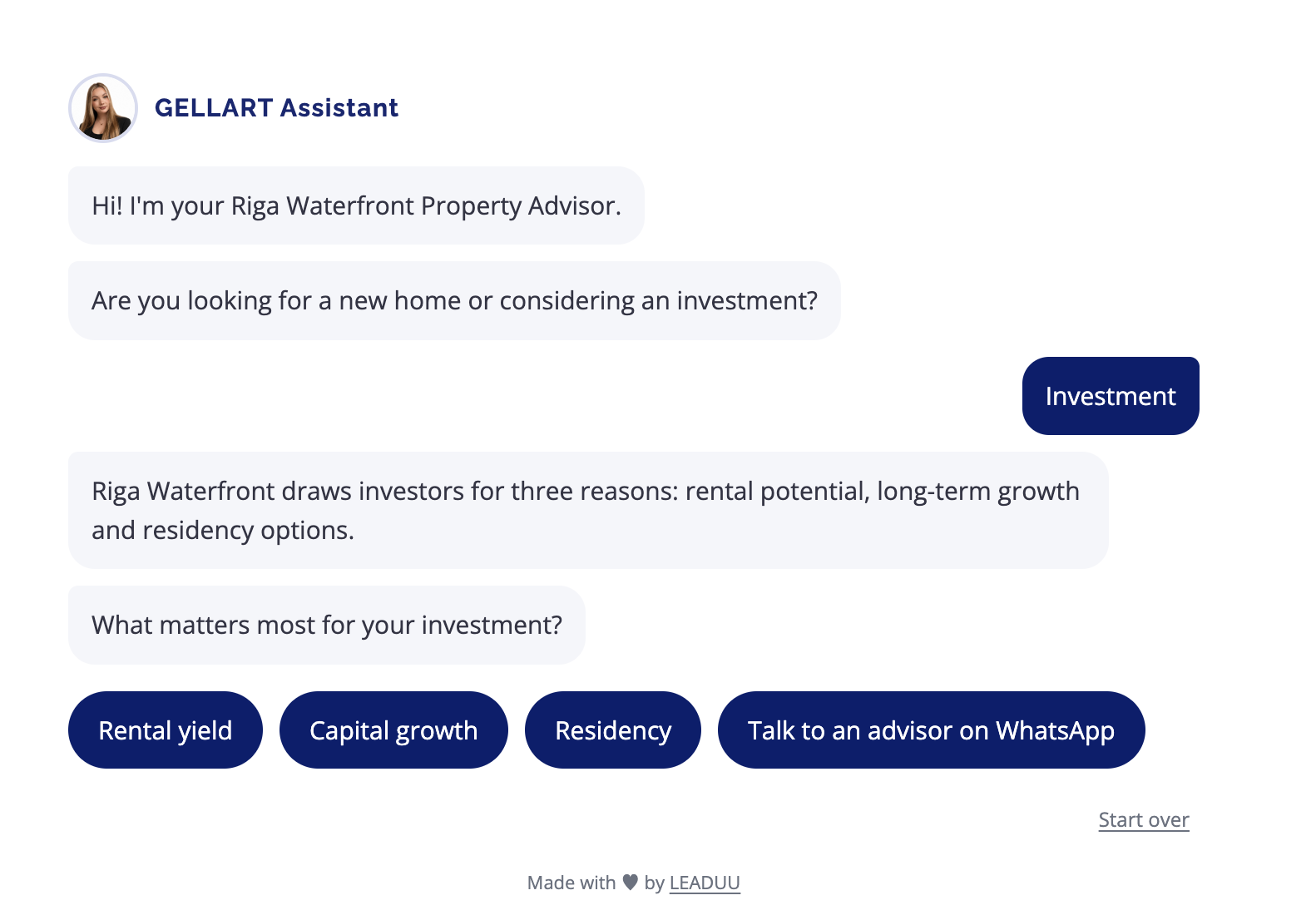
Riga Waterfront, a residential development on the river in Riga, runs a Leaduu in-page bot directly on its project website. The mechanics are exactly what this article describes:
- •A named assistant greets the visitor on the page — inside the content, not over it.
- •The first question splits traffic: "Are you looking for a new home or considering an investment?"
- •Investors are asked what matters most: rental potential, long-term growth, or residency options — the three questions that actually drive investment purchases in the Baltic market.
- •Every path ends with a low-friction handoff, the main one being a WhatsApp conversation with an advisor — in WhatsApp's own green button, a colour every visitor recognises instantly.
No form, no typing, no waiting for an operator. The visitor makes three or four taps and lands in a conversation with a human who already knows what they want. You can see the full breakdown on our homepage case section, or open the live site and try the bot yourself.
How to add a chatbot to your real estate website
The technical part is deliberately boring: an in-page chatbot installs with one script tag. It works on WordPress, Webflow, custom-built sites — anything that renders HTML. No redesign, no developer project, no migration. The bot inherits its place in your page, and the flows are configured around your project: your unit types, your budget ranges, your languages, your WhatsApp number.
The honest way to evaluate a website chatbot for real estate is simply to use one. The bot on our homepage is the same product described in this article — same guided flow, same WhatsApp handoff. Click through it as if you were a buyer and notice how different it feels from filling in a form.
Leaduu is currently onboarding property developers and agencies in early access, with pricing available on request. If you would rather talk first, the bot will happily arrange that too — it is rather good at booking calls.
Frequently asked questions
What is an in-page chatbot?
An in-page chatbot is a conversational assistant embedded directly into the content of a web page, rather than floating over it as a popup widget. Visitors meet it while scrolling, exactly where their questions arise, and interact through guided button flows — no typing required. Because it does not interrupt anyone, it avoids the reflexive close that kills most popup chat windows.
How is an in-page chatbot different from live chat?
Live chat depends on a human operator being available and typically appears as a popup that most visitors dismiss without reading. An in-page chatbot works autonomously 24/7, engages visitors inside the page content, and qualifies leads automatically with button-based questions. Sales staff only get involved once a lead is qualified and handed over — usually via WhatsApp with full context attached.
Do I need a developer to install a chatbot on my real estate website?
No. An in-page chatbot like Leaduu installs with a single script tag, which takes a few minutes on WordPress, Webflow, or any custom-built site. There is no redesign and no migration — the bot appears inside your existing pages, and the conversation flows are configured for your project by the Leaduu team.
Can a chatbot book property viewings?
Yes. A well-designed real estate chatbot offers viewing or video-call booking as one of its conversion paths: the visitor picks a day and time inside the conversation, leaves a contact detail, and the appointment request lands with your sales team together with the lead's intent and budget. No phone tag, no email back-and-forth.
How does WhatsApp handoff work?
When a visitor finishes the qualification flow and chooses WhatsApp, the bot opens a WhatsApp conversation with your sales number, pre-filled with the context of their answers — for example their buyer type, main interest, and budget range. Your manager sees who they are talking to before saying hello, and the buyer never has to repeat themselves.
How much does a real estate chatbot cost?
Pricing varies by provider and by how much traffic and how many projects you run. Leaduu is currently in early access for property developers and agencies, with pricing available on request — the fastest way to get a number is to join the waitlist on leaduu.com or ask the demo bot on the homepage to arrange a call.
Ready to convert more visitors?
Try the live Leaduu bot — the same one your visitors will see.
Try the live bot →